The global pursuit of sustainable nuclear energy has long been shadowed by the challenge of radioactive waste. Traditional reactors leave behind long-lived isotopes that remain hazardous for millennia, demanding secure storage solutions that test both engineering and political will. Yet a transformative technology is emerging from laboratories and pilot projects: the accelerator-driven transmutation reactor, a system that could rewrite the rules of nuclear waste management.
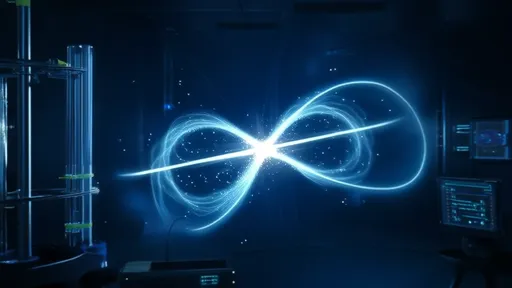
At its core, this technology marries particle physics with nuclear engineering. A high-powered proton accelerator fires particles at a heavy metal target, typically lead or tungsten, generating an intense neutron flux through spallation reactions. These free neutrons then bombard spent nuclear fuel, inducing fission in actinides like plutonium and americium while transmuting other isotopes into shorter-lived or stable elements. The process doesn't eliminate radioactivity entirely but compresses the danger timeline from geological epochs to human generations.
What sets these systems apart is their inherent safety architecture. Unlike conventional reactors that require precise neutron economy to maintain criticality, accelerator-driven systems (ADS) operate in a subcritical regime. The nuclear reaction ceases instantly when the proton beam switches off—a failsafe mechanism that prevents meltdown scenarios. This characteristic has drawn particular interest from nations phasing out traditional reactors but grappling with existing waste stockpiles.
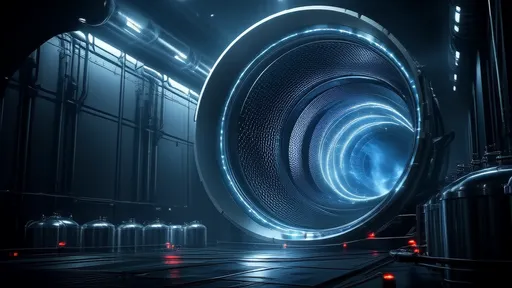
The technical hurdles remain substantial. Maintaining a high-current, megawatt-class proton accelerator for years of continuous operation pushes the boundaries of particle accelerator technology. Target materials must withstand unprecedented radiation damage while immersed in molten salts or heavy metal coolants. Recent breakthroughs in superconducting radiofrequency cavities and liquid metal corrosion inhibitors suggest these challenges may soon yield to engineering solutions.
Pilot projects worldwide are demonstrating the technology's viability. China's CiADS facility in Guangdong Province aims to demonstrate 10 MW thermal power operation by 2025. Europe's MYRRHA project in Belgium progresses through its phased construction, with neutron beam experiments already underway. These aren't theoretical exercises but billion-euro commitments to industrial-scale development.
The geopolitical implications could prove as significant as the technical achievements. Nations currently dependent on others for long-term waste storage may gain autonomy over their nuclear legacy. The technology could also reshape nonproliferation discussions—while ADS systems can destroy weapons-usable plutonium, they also produce knowledge applicable to advanced weapons design. This dual-use nature ensures the technology will develop under intense international scrutiny.
Environmental assessments paint a complex picture. Transmutation reduces radiotoxicity but increases the volume of intermediate-level waste. The energy required to power the accelerators diminishes the net energy gain, though some designs integrate power production. Lifecycle analyses suggest the greatest benefits emerge when treating legacy waste rather than supporting continuous energy generation.
Economic models remain contentious. Current estimates place the levelized cost well above conventional nuclear power, let alone renewables. However, these calculations rarely account for the avoided costs of geological repositories—facilities whose price tags often spiral into tens of billions with multi-century maintenance commitments. The financial equation shifts dramatically when considering waste already destined for permanent storage.
The coming decade will prove decisive. As pilot facilities transition from blueprints to operational status, hard data will replace projections. Success could see these systems deployed first as waste treatment adjuncts to existing reactors, later evolving into stand-alone energy generators. Failure might relegate transmutation to a footnote in nuclear history—another promising solution undone by material limits or economic realities.
What emerges is neither a silver bullet nor a white elephant, but a sophisticated tool for managing humanity's most persistent energy byproduct. In an era demanding climate action and responsible stewardship, accelerator-driven transmutation offers a path to reconcile nuclear power's promise with its environmental legacy. The atoms we once feared may yet become those we harness.

By /Aug 14, 2025

By /Aug 14, 2025

By /Aug 14, 2025

By /Aug 14, 2025
By /Aug 14, 2025
By /Aug 14, 2025

By /Aug 14, 2025
By /Aug 14, 2025

By /Aug 14, 2025
By /Aug 14, 2025

By /Aug 14, 2025
By /Aug 14, 2025
By /Aug 14, 2025
By /Aug 14, 2025
By /Aug 14, 2025
By /Aug 14, 2025
By /Aug 14, 2025
By /Aug 14, 2025

By /Aug 14, 2025
By /Aug 14, 2025