The quest for renewable energy has taken a bold leap into the skies with the development of stratospheric wind farms—a revolutionary concept that could redefine how we harness wind power. Unlike traditional wind turbines anchored to the ground, these futuristic systems utilize helium balloons to suspend turbines high in the stratosphere, where winds are stronger and more consistent. This innovative approach promises to overcome many of the limitations faced by conventional wind energy, offering a glimpse into a cleaner, more efficient future.
The stratosphere, located between 10 and 50 kilometers above the Earth's surface, is home to jet streams—narrow bands of powerful, high-altitude winds that flow at speeds far exceeding those at ground level. Engineers and scientists have long theorized that tapping into these relentless winds could yield unprecedented energy generation. Now, with advancements in materials science and aerodynamics, this vision is inching closer to reality.
How It Works: The Mechanics of Stratospheric Wind Farms
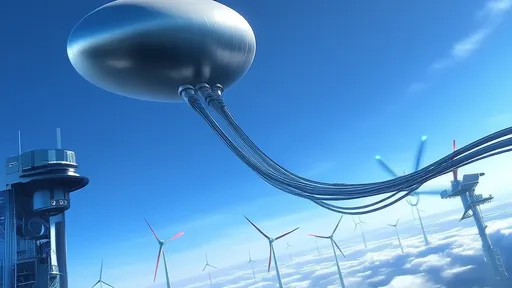
At the heart of this technology are helium-filled balloons or aerostats, which serve as floating platforms for lightweight, high-efficiency turbines. Tethered to the ground by ultra-strong, conductive cables, these balloons can ascend to altitudes where wind speeds are optimal. The turbines, often smaller and more aerodynamic than their terrestrial counterparts, spin rapidly in the stratospheric winds, generating electricity that is transmitted down the tether to storage or grid systems on the surface.
One of the most compelling advantages of this system is its ability to operate above weather disturbances. Traditional wind farms are subject to the vagaries of surface weather, including storms and seasonal variations. In contrast, stratospheric winds are remarkably stable, providing a near-constant energy source. Additionally, the higher energy density of these winds means that smaller turbines can produce comparable or even greater output than larger ground-based units.
Overcoming Challenges: From Concept to Commercial Viability
Despite its promise, the path to commercializing stratospheric wind energy is fraught with technical and logistical hurdles. Ensuring the durability of materials in the harsh, low-temperature environment of the stratosphere is a primary concern. The tethers must withstand not only the mechanical stresses of high winds but also potential lightning strikes and icing. Moreover, the safe deployment and retrieval of these systems—especially in crowded airspace—require sophisticated navigation and collision-avoidance technologies.
Regulatory frameworks present another layer of complexity. Airspace management authorities must develop new protocols to accommodate these airborne generators without disrupting aviation. Environmental impacts, such as the effect of helium use (a finite resource) and potential interference with atmospheric conditions, also warrant careful study.
Pioneering Projects and Global Interest
Several startups and research consortia worldwide are racing to bring stratospheric wind farms to fruition. Companies like Altaeros Energies and SkySails Power have already demonstrated prototypes, showcasing the feasibility of airborne wind energy. In Japan, a government-backed initiative recently tested a helium-based turbine at altitudes exceeding 300 meters, with plans to scale up to stratospheric heights in the coming years.
Europe, too, is investing heavily in this emerging field. The European Space Agency has explored the potential of high-altitude wind farms as part of its sustainable energy initiatives, while private firms in Germany and the Netherlands are experimenting with kite-based systems that complement balloon-tethered designs.
The Future of Wind Energy: A Sky-High Perspective
If successfully scaled, stratospheric wind farms could revolutionize renewable energy production. Their ability to generate power continuously—unhindered by nighttime or calm conditions—positions them as a potential baseload energy source, a role traditionally filled by fossil fuels or nuclear power. Furthermore, their minimal land use makes them ideal for densely populated or ecologically sensitive regions where ground-based renewables are impractical.
As research progresses and pilot projects multiply, the dream of drawing energy from the skies is becoming increasingly tangible. While challenges remain, the fusion of aerospace engineering and renewable energy technology heralds a new era in humanity’s pursuit of sustainability—one where the winds of the stratosphere may soon light up our homes and industries.
A New Horizon for Clean Energy
The development of helium balloon-tethered wind turbines exemplifies the innovative spirit driving the renewable energy sector. By looking upward—literally—engineers are unlocking a vast, untapped reservoir of wind energy that could play a pivotal role in the global transition away from fossil fuels. As this technology matures, it may well become a cornerstone of the world’s energy infrastructure, proving that sometimes, the best solutions are found by rising above the fray.

By /Aug 14, 2025

By /Aug 14, 2025

By /Aug 14, 2025

By /Aug 14, 2025
By /Aug 14, 2025
By /Aug 14, 2025

By /Aug 14, 2025
By /Aug 14, 2025
By /Aug 14, 2025
By /Aug 14, 2025
By /Aug 14, 2025
By /Aug 14, 2025

By /Aug 14, 2025

By /Aug 14, 2025

By /Aug 14, 2025
By /Aug 14, 2025

By /Aug 14, 2025
By /Aug 14, 2025

By /Aug 14, 2025

By /Aug 14, 2025
