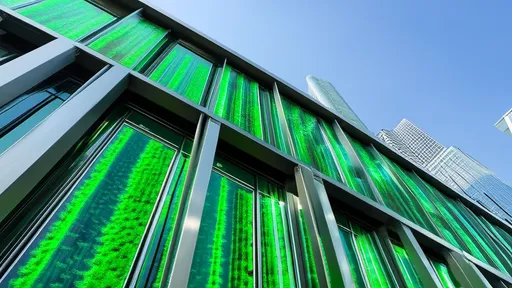
The concept of integrating living systems with architectural design has taken a revolutionary leap forward with the advent of algae-powered glass bio-façades. These innovative structures, often referred to as photosynthetic building skins, are transforming urban landscapes by merging energy production with ecological aesthetics. Unlike traditional solar panels, which merely harvest sunlight, these bio-reactive façades harness the metabolic power of microalgae to generate electricity while simultaneously improving air quality and thermal insulation.
At the heart of this technology lies a sophisticated symbiosis between biology and engineering. Thin, transparent panels filled with nutrient-rich water house colonies of Chlorella or Spirulina, fast-growing microalgae species selected for their photosynthetic efficiency. As sunlight penetrates the glass, the algae undergo photosynthesis—absorbing CO₂ and releasing oxygen—while their biomass growth creates a continuous harvestable energy source. The harvested algae can then be processed into biofuels or used as raw material for bioplastics, creating a closed-loop system that challenges conventional notions of renewable energy infrastructure.
What makes these living walls particularly compelling is their dynamic responsiveness to environmental conditions. On cloudy days, the algae adjust their photosynthetic activity, while during peak sunlight, their rapid growth provides natural shading that reduces building cooling loads by up to 30%. This adaptive quality has captured the attention of architects working in climate-responsive design, offering a solution that evolves with seasonal changes rather than relying on mechanical interventions.
The implementation of algae glass façades requires meticulous engineering to balance biological needs with architectural demands. Specialized photobioreactor panels maintain optimal temperature, pH levels, and nutrient circulation—parameters monitored through embedded IoT sensors. Recent advancements in nano-coatings prevent biofilm accumulation on glass surfaces while allowing maximum light penetration, addressing early challenges of maintenance and efficiency loss that plagued prototype installations a decade ago.
From an urban planning perspective, these photosynthetic surfaces represent more than energy generators—they're vertical ecosystems that reintroduce biodiversity into concrete jungles. Early adopters in European cities have reported measurable improvements in local air quality near buildings equipped with algae façades, with some structures offsetting up to 40% of their operational energy needs. The psychological benefits shouldn't be underestimated either; office workers in such buildings report higher productivity and reduced stress levels when working alongside these gently undulating green walls.
Critics initially questioned the economic viability of algae-integrated architecture, but plummeting bioreactor costs and rising energy prices have shifted the calculus. Modern systems achieve payback periods comparable to conventional solar arrays when factoring in energy savings from improved insulation and reduced HVAC demands. Perhaps most intriguing is the technology's scalability—from small retrofit panels for historic buildings to vast curtain walls on skyscrapers, each implementation contributes to a distributed network of urban carbon capture.
The aesthetic possibilities are equally transformative. Unlike the static appearance of traditional building materials, algae façades change appearance throughout the day as sunlight alters the density and movement of microorganisms within the panels. Some architects are programming growth patterns through controlled lighting to create living murals, while others exploit the algae's natural phototaxis to create kinetic displays that respond to sunlight angles.
As climate resilience becomes non-negotiable in urban development, algae glass technology demonstrates how biophilic design can transcend symbolism to become functional infrastructure. Research institutions are already developing next-generation systems incorporating genetically enhanced algae strains with higher lipid content for increased biofuel yield. When paired with emerging technologies like transparent photovoltaic coatings, the potential exists for buildings to become net-positive energy producers while actively reducing urban carbon footprints—a vision where architecture doesn't just minimize environmental harm but actively regenerates ecosystems.
The implications extend beyond individual buildings to urban microclimates. Computer modeling suggests that widespread adoption could reduce heat island effects in dense cities by 2-3°C through combined shading and evapotranspiration. Water management integration allows these systems to filter greywater while growing biomass, creating circular water-energy systems particularly valuable in arid regions. Such multifunctionality exemplifies the paradigm shift toward living infrastructure that characterizes cutting-edge sustainable design.
While technical challenges remain—particularly regarding winter performance in temperate climates and standardization of maintenance protocols—the trajectory is clear. Major architecture firms now include algae-integrated designs in their sustainability portfolios, and pilot projects have moved beyond Europe to Asia and North America. As with any emerging technology, early installations serve as both proof-of-concept and cultural adaptation, gradually shifting perceptions of what buildings can and should do in the Anthropocene era.
What began as speculative research in university labs has matured into a viable architectural movement with its own design language. The algae glass façade represents more than an energy innovation—it's a philosophical statement about humanity's place within natural systems. By creating buildings that breathe, grow, and contribute to their ecosystems, architects are rewriting the relationship between urban environments and the biosphere, one photosynthetic panel at a time.

By /Aug 14, 2025

By /Aug 14, 2025

By /Aug 14, 2025

By /Aug 14, 2025

By /Aug 14, 2025

By /Aug 14, 2025
By /Aug 14, 2025

By /Aug 14, 2025

By /Aug 14, 2025
By /Aug 14, 2025
By /Aug 14, 2025

By /Aug 14, 2025

By /Aug 14, 2025

By /Aug 14, 2025

By /Aug 14, 2025

By /Aug 14, 2025

By /Aug 14, 2025

By /Aug 14, 2025

By /Aug 14, 2025

By /Aug 14, 2025
