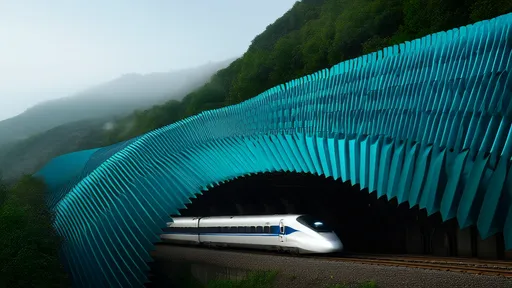
High-speed rail networks have revolutionized modern transportation, but they bring with them a unique set of challenges—chief among them, the sonic boom effect when trains enter tunnels at high velocities. Engineers and researchers are now turning to nature for inspiration, specifically the kingfisher bird, to mitigate this issue. The bird’s sleek, hydrodynamic beak has become the blueprint for designing quieter, more aerodynamically efficient high-speed trains.
The phenomenon known as "tunnel boom" occurs when a train rushes into a confined tunnel space, compressing air rapidly and creating a pressure wave that exits the tunnel with a loud bang. This not only disturbs wildlife and communities near rail lines but also places stress on the train’s structural integrity. Traditional solutions have focused on reinforcing tunnels or altering train speeds, but these methods are often costly and inefficient. Biomimicry, the practice of emulating nature’s designs, offers a more elegant alternative.
Kingfishers dive into water at high speeds with minimal splash, thanks to their elongated, wedge-shaped beaks that reduce hydrodynamic drag. By applying similar principles to train nose designs, engineers have developed streamlined fronts that slice through air more smoothly, significantly reducing the abrupt pressure changes that cause sonic booms. Japanese bullet trains were among the first to adopt this concept, resulting in a noticeable drop in noise pollution and energy consumption.
Beyond the nose cone, researchers are examining the entire aerodynamic profile of high-speed trains. Turbulence around the train’s body, roof, and undercarriage can exacerbate noise levels when entering tunnels. Subtle modifications, such as smoothing out edges and adding fin-like protrusions, help channel airflow more efficiently. Computational fluid dynamics (CFD) simulations play a crucial role in testing these adaptations before physical prototypes are built, saving both time and resources.
Material science also contributes to noise reduction. Lightweight composites that absorb vibrations, combined with perforated panels that dissipate sound waves, are being integrated into tunnel linings and train exteriors. These materials not only dampen noise but also enhance the overall durability of the infrastructure. The synergy between aerodynamic design and advanced materials is paving the way for quieter, faster, and more sustainable rail systems.
While the kingfisher-inspired design marks a significant leap forward, the quest for perfection continues. Engineers are now studying other avian and aquatic species, such as owls and dolphins, to further refine aerodynamics and acoustics. The goal is to achieve a near-silent high-speed rail network that blends seamlessly into both urban and rural landscapes.
The implications of this research extend beyond passenger comfort. Reduced noise levels mean fewer restrictions on train operations, allowing for higher speeds and more frequent services without disturbing nearby communities. Additionally, lower aerodynamic drag translates to decreased energy consumption, aligning with global efforts to cut carbon emissions from transportation.
As high-speed rail expands globally, the lessons learned from biomimicry will become increasingly vital. From the tunnels of Japan to the burgeoning rail networks of Europe and North America, nature’s ingenuity is helping to shape the future of transportation. The humble kingfisher, once merely a subject of ornithological interest, now stands as a symbol of innovation in engineering.
By /Aug 12, 2025
By /Aug 12, 2025
By /Aug 12, 2025

By /Aug 12, 2025

By /Aug 12, 2025
By /Aug 12, 2025
By /Aug 12, 2025

By /Aug 12, 2025

By /Aug 12, 2025

By /Aug 12, 2025

By /Aug 12, 2025
By /Aug 12, 2025

By /Aug 12, 2025

By /Aug 12, 2025

By /Aug 12, 2025

By /Aug 12, 2025

By /Aug 12, 2025
By /Aug 12, 2025

By /Aug 12, 2025
By /Aug 12, 2025
